





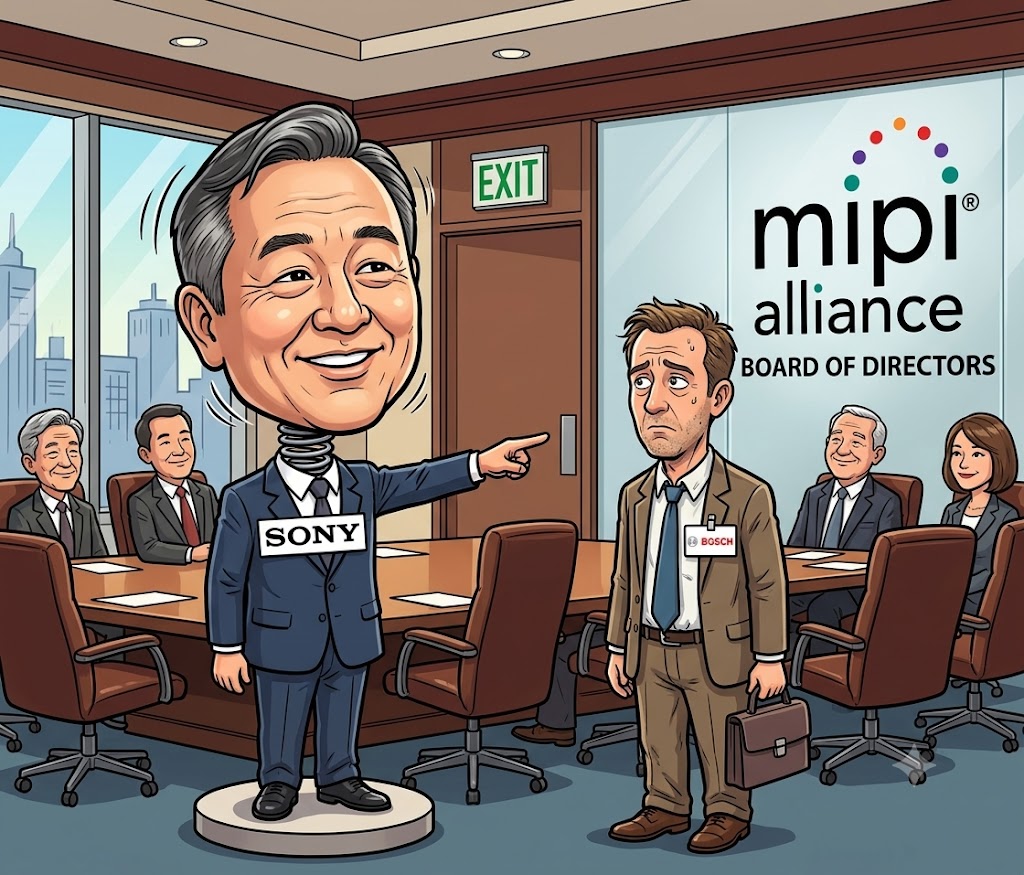
Boardroom Shift Reflects Growing Sensor Influence
The MIPI Alliance has promoted Sony Semiconductor Solutions to Promoter membership, granting the Japanese image sensor specialist its first seat on the organization’s board of directors. Sony assumes the position previously held by Bosch, joining an eight member panel that includes Google, Intel, Qualcomm, Samsung Electronics, STMicroelectronics, Synopsys, and Texas Instruments. Hiroo Takahashi, Deputy General Manager at Sony Semiconductor Solutions, will represent the company on the board.
Sony has been an active MIPI participant since 2007, contributing to working groups that develop physical layer interfaces (A PHY, C PHY, and D PHY) as well as Camera, I3C, and Security specifications. The company’s work on Camera Serial Interface 2, the most widely deployed embedded vision interface, earned the MIPI Alliance 2018 Corporate Award. This elevation signals a strategic shift toward sensor specialist representation in the development of interface standards.
Automotive Implications of the MIPI Standards Shift
MIPI specifications span applications from mobile devices to automotive systems and physical AI, areas where Sony’s image sensing portfolio has growing relevance. For connected vehicles, MIPI A PHY is a key standard supporting high speed data transmission for camera based advanced driver assistance systems (ADAS) and autonomous driving sensors. Sony’s board level influence could shape how future specifications address the bandwidth and security requirements of automotive perception systems, including camera feeds for ADAS, surround view monitoring, and driver monitoring.
The elevation also impacts the automotive supply chain as OEMs and tier 1 suppliers increasingly rely on MIPI based interconnects for in vehicle networks. Sony’s expertise in image sensor security and data integrity could drive enhancements to MIPI Security specifications, which govern protection of sensor data streams. This is particularly relevant as vehicles adopt more camera dependent features and over the air update mechanisms for perception software.
Source: Automotiveworld