


When you hear “car hacking,” you probably imagine someone in a hoodie cloning a key fob in a parking lot. But there’s another kind of hacking happening in driveways across America — and it’s saving lives.
Rivian owners are reverse-engineering their own vehicles. Not to steal them, but to fix a dangerous design flaw their $70,000 electric trucks shipped with. And honestly? It’s the most inspiring automotive security story we’ve seen in a while.
The Problem: A Door You Can’t Open in a Crash
Rivian’s Gen 2 R1S and R1T use electronic door releases — like most modern EVs. They look sleek, they’re aerodynamic, and they work great until the 12V battery dies or the CAN bus goes silent after a crash. At that point, you need the manual backup.
In the Gen 2 refresh, Rivian moved the rear door emergency release inside the door panel. To access it, you need a pry tool, you need to remove a trim piece with considerable force, and then you need to fish blindly for a small cord buried deep inside the door cavity. In an emergency — smoke, panic, injured passengers — this is not going to happen.
It’s even worse if a child is in the back. A kid can’t pry trim panels. A kid can’t grope for a hidden cord. If the power cuts and the doors don’t open, they’re trapped.
The Hack: Paracord, Carabiners, and Community Ingenuity
Rivian owners on Reddit did what automakers wish they wouldn’t: they cracked open their door panels and fixed it themselves.
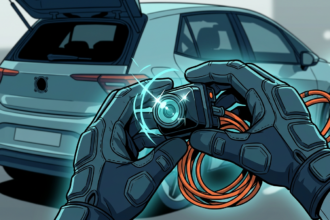
User dublew_dubs posted a DIY guide showing how to attach a length of paracord to the factory manual release cord, routing it to a visible location inside the cabin. The modification is completely reversible, uses parts you can buy for under $10, and turns an impossible emergency procedure into a simple pull.
Another owner, AlsonCentral, went a step further with a steel cable, a small carabiner, and a metal ring to create a positive-action release that even a child can operate. “We showed our kids and made them solemnly promise not to use it except in an emergency,” they wrote, “because it can open the door even when you’re going 70 mph.”
That last detail matters: these hacks override the electronic door lock entirely. In normal operation, the electronic system prevents the rear doors from opening while the vehicle is moving. The manual release bypasses that — which is the whole point in an emergency, but also means these DIY releases demand responsible use.
The Bigger Picture: When Safety Design Falls Short
This isn’t a Rivian-exclusive problem. Tesla has been under scrutiny for years over electronic door handles that left passengers and first responders struggling to open doors after crashes. In December 2025, Bloomberg ran a story on Tesla owners buying escape tools and window smashers after traumatizing experiences. Earlier this year, NHTSA opened a preliminary investigation into Tesla’s door handles as a potential safety defect.
Tesla’s design chief Franz von Holzhausen has said the company is working on combining electronic and manual releases into a single mechanism. Rivian has similarly promised redesigned handles for the upcoming R2. But promises don’t help the family driving home in a Gen 2 R1S today.
The real question is: why did it take owners hacking their own cars for this to become a conversation?
Good Hacking vs. Bad Hacking
There’s a meaningful distinction here that often gets lost in the automotive security discourse. The carabiner-and-paracord mod is an owner improving their vehicle’s safety using physical access to the door panel. It’s not CAN injection, it’s not OBD exploitation, it’s not a relay attack. It’s mechanical augmentation.
But it raises a fascinating edge case for cybersecurity engineers: when the vehicle’s electronic safety systems create a physical safety hazard, who’s responsible for the gap? The owner who patches it with a $3 carabiner, or the manufacturer who buried the manual release behind trim that requires a pry tool to access?
The Right Response
Rivian and Tesla have both said they’ll improve emergency release designs on future vehicles. That’s the right answer long-term. But in the short term, these DIY fixes are a masterclass in pragmatic safety engineering:
- They’re reversible — no permanent modification to the vehicle
- They’re testable — you can practice the release in your driveway
- They’re visible — a bright paracord with a carabiner is unmistakably a pull-handle
- They cost less than a takeout dinner
That’s the kind of hacking we should celebrate. Not exploit code and stolen key fobs, but owners taking safety into their own hands when the engineering falls short.
Here’s hoping the R2 and Cybertruck 2.0 ship with emergency releases a child can actually reach. Until then, Rivian owners have shown us exactly what community-driven safety looks like.
Stay safe. Stay curious. And maybe buy some paracord.
Source: InsideEVs