
CarThreat
  • Home
  • News
  • Features
  • Spotlight
  • Events
  • About
    • Our Mission
    • Services
    • Contact
Notification
  • Autonomous Driving
  • Automotive Ethernet
  • BMS
  • ECU
  • EV
  • ISO/SAE 21434
  • Infotainment
  • OTA Updates
  • OBD-II
  • Pwn2Own
  • RCE
  • SDVs
  • TCU
  • UNECE R155
Cybersecurity

Britain admits 125,000 public chargers have no uniform cyber bar

Cybersecurity

Bosch puts a security gatekeeper on connected motorcycles

Cybersecurity

Trucking group opens a capture-the-flag lab for mechanics

Physical Security

Two California drivers test Axon’s plate database in court

Font ResizerAa
CarThreatCarThreat
  • Home
  • News
  • Features
  • Spotlight
  • Events
  • About
Search
  • Home
  • News
  • Features
  • Spotlight
  • Events
  • About
    • Our Mission
    • Services
    • Contact
Sign In Sign In
Follow US
© 2026 Carthreat.com. All right reserved.
Cybersecurity

Tata’s connected car apps shipped their own keys to attackers

India's cyber agency wants 2.0 and iRA.ev owners upgrading now, after four high-severity bugs let outsiders act as a logged-in driver.

CarThreat Staff
Last updated: November 5, 2026 9:33 pm
By
ctadmin
2 Min Read
SHARE

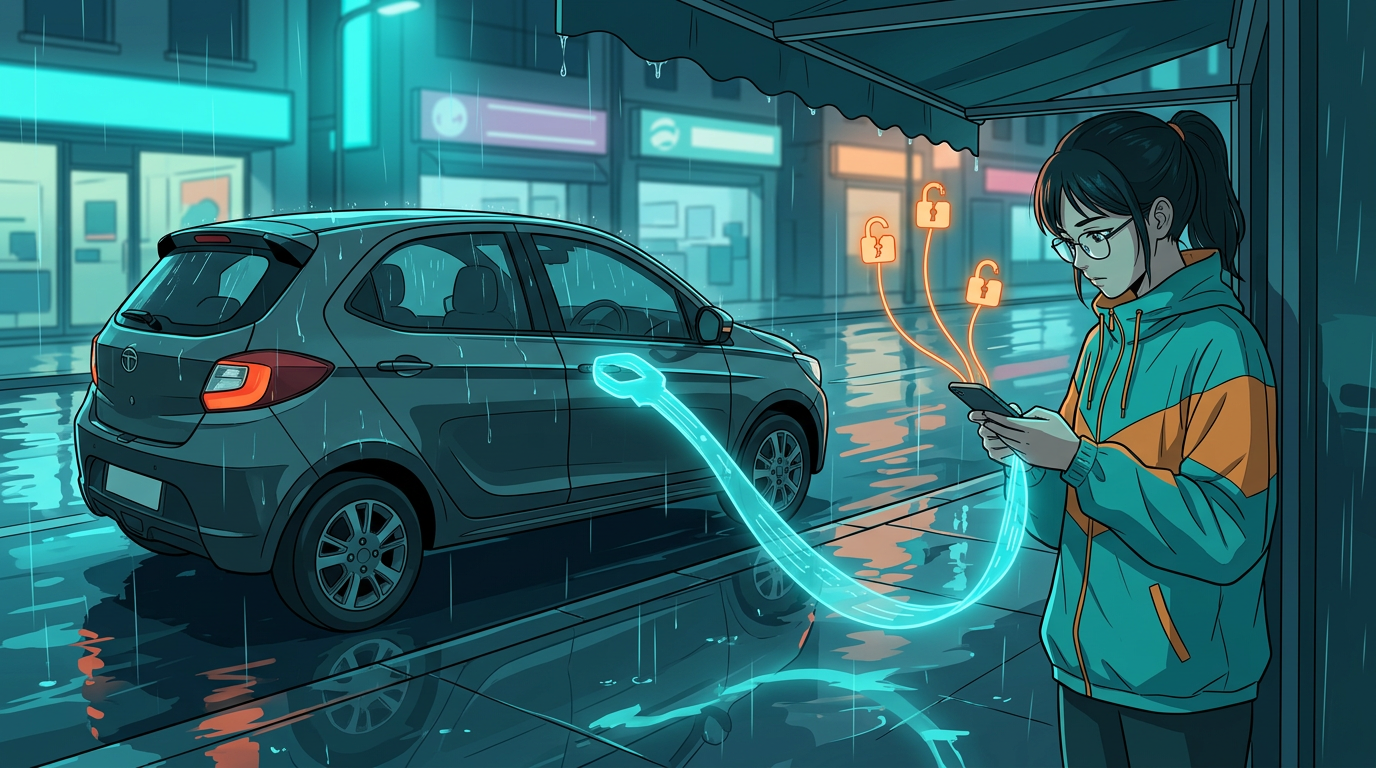
India’s national cyber agency told Tata Motors owners on November 4 to update two connected-car apps, after finding four high-severity flaws that let an outsider act as the person holding the phone.

Contents
Credentials that never needed stealingWhat the agency did not claim

The advisory covers iRA 2.0 up to build 26.7.3 and the electric-car version iRA.ev up to 26.7.2. Both apps issue remote commands, report vehicle health and hold trip history.

Credentials that never needed stealing

The most serious issue, CVE-2026-121144, rated 8.8, is a hardcoded-credential bug: service account logins, API keys and authorization tokens sit inside the app package itself. Anyone who downloads the file can unpack it and walk away with backend access, no password required.

CVE-2026-121145 lives in the embedded WebView. Missing origin checks on loaded pages let hostile content reach live bearer tokens, which can then be replayed as the owner.

A third bug, CVE-2026-121146, writes session tokens into development logs, exposing them to anyone with local access. The fourth, CVE-2026-121147, leaves SSL certificate pinning effectively broken, so a network interceptor can read or alter app-to-server traffic.

What the agency did not claim

CERT-In named researcher Pranav Rajendran as the reporter and published no evidence of exploitation, no affected models and no demonstration of driving controls being seized. The documented risk is impersonation, data theft and unauthorized changes made with an owner’s privileges.

CERT-In lists build 26.8.2 for iRA 2.0 and 26.9.1 for iRA.ev as the fix, with no interim workaround offered. Tata Motors told ET Auto the issues were addressed through updates and that customer data is safe.

The pattern is familiar from earlier connected-vehicle API research: the phone app and its backend, not the wiring harness, now carry an owner’s authority. A copied build of that app is a credential store.
Join Our Newsletter
Subscribe to our newsletter to get our newest articles instantly!
TAGGED:Connected VehiclesCybersecurityData PrivacyRemote Code Execution (RCE)Vehicle SoftwareVulnerabilities
SOURCES:CERT-InCyber Security NewsET Auto
Share This Article
Facebook Email Copy Link

Follow US

Find US on Social Medias
FacebookLike
XFollow
YoutubeSubscribe

You Might Also Like

CybersecurityPolicy & Compliance

Six weeks pass and Flock still has not changed the rules

By
ctadmin
November 2, 2026
A dealership forecourt at night with a glowing cable running from the back office between parked cars
Cybersecurity

Car dealer networks face a year of relentless attacks, mostly phishing

By
ctadmin
September 30, 2026
Cybersecurity

A seller is offering French plate numbers tied to owner addresses

By
ctadmin
October 28, 2026
Anime illustration of corrupted data racing up an EV charging cable toward the car
Electric Vehicles

Open Charge Alliance will review Korean tool that hijacked an EV charger

By
ctadmin
September 3, 2026
Cybersecurity

US Bans Polestar EV Sales Under National Security Connected Vehicle Rule

By
ctadmin
July 1, 2026
Cybersecurity

EcoMotion Panel Explores Self Protecting ECUs as Alternative to Network Security

By
ctadmin
May 22, 2026

CarThreat

Intelligence for the EV and automotive security market
  • News
  • Features
  • Spotlight
  • Events
  • About Carthreat
  • Our Mission
  • Services
  • Contact Us
  • OBD-II
  • Automotive Ethernet
  • TCU
  • Infotainment Systems
  • SDVs
  • BMS
  • ECU Security
  • CAN Bus
  • Vulnerabilities
  • Relay Attacks
  • RCE
  • Threat Intelligence
  • Cybersecurity
  • Digital Keys
  • Bluetooth Security
  • OTA Updates
  • ISO/SAE 21434
  • UNECE R155
  • Regulations
  • Data Privacy
  • EVs
  • Autonomous Driving
  • Pwn2Own Automotive

© 2026 Carthreat.com. All right reserved.  Privacy Policy | Legal

Welcome Back!

Sign in to your account

Username or Email Address
Password

Lost your password?