
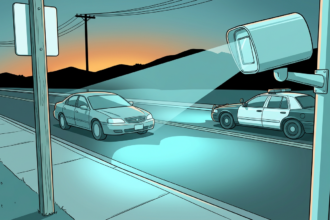


The case is Mun v. Axon Enterprise, not a hack. Filed on November 3 in the Northern District of California, it targets the paperwork side of a fast-growing plate-reading network.
What the complaint says
Two drivers, from Daly City and Palm Desert, argue Axon runs over 1,000 cameras in the state but never posted the privacy policy California’s ALPR law requires of operators.
That gap leaves residents unable to learn who can view a plate, how long a read is kept, who receives it, and how a wrong entry gets corrected.
Axon arrived from body cameras. The filing says cruiser-mounted Fleet 3 readers date to 2021, with fixed Outpost and Lightpost units added in 2025.
The numbers behind the claim
Fremont cameras logged nearly 5 million plate reads in one 90-day window, per a records response cited in the filing. More than 1,600 Los Angeles Police Department vehicles carry Axon Fleet hardware.
Counsel Hausfeld and Gibbs Mura want at least $2,500 per violation, punitive damages and an injunction. The class would cover anyone whose California plate data passed through Axon since November 2023.
The filing also cites 75 documented misuse cases nationwide to argue that a published policy is the only real check on who looks.
Why disclosure is the weak point
Axon’s documentation describes tenant isolation, encrypted uploads to CJIS-certified storage and offense-category limits on cross-agency searches.
Those controls govern technical access. They do not answer whether an operator must publish, in plain language, what it collects.
Axon had not responded as of November 4. It is Gibbs Mura’s third such suit, after cases against Flock Safety and Motorola Solutions.
Where Axon fits in the market
Los Angeles picked Axon after declining to renew with Flock, so procurement and litigation are now moving at the same speed.