

CarThreat
  • Home
  • News
  • Features
  • Spotlight
  • Events
  • About
    • Our Mission
    • Services
    • Contact
Notification
  • Autonomous Driving
  • Automotive Ethernet
  • BMS
  • ECU
  • EV
  • ISO/SAE 21434
  • Infotainment
  • OTA Updates
  • OBD-II
  • Pwn2Own
  • RCE
  • SDVs
  • TCU
  • UNECE R155
Cybersecurity

Britain admits 125,000 public chargers have no uniform cyber bar

Cybersecurity

Bosch puts a security gatekeeper on connected motorcycles

Cybersecurity

Trucking group opens a capture-the-flag lab for mechanics

Physical Security

Two California drivers test Axon’s plate database in court

Font ResizerAa
CarThreatCarThreat
  • Home
  • News
  • Features
  • Spotlight
  • Events
  • About
Search
  • Home
  • News
  • Features
  • Spotlight
  • Events
  • About
    • Our Mission
    • Services
    • Contact
Sign In Sign In
Follow US
© 2026 Carthreat.com. All right reserved.
Cybersecurity

PolyU shows how charger apps could tip a neighbourhood grid

Attacks that never touch a utility network can still push a local grid past its limit by steering drivers toward the same plug.

CarThreat Staff
Last updated: October 23, 2026 12:19 am
By
ctadmin
2 Min Read
SHARE

Breaking into a regional grid usually means beating hardened, purpose-built communications equipment. A Hong Kong Polytechnic University team argues a cheaper route runs through the app a driver opens to find a plug.

Contents
Where two well-defended systems meetThe soft part is public

Prof. Bu Siqi, of the Department of Electrical and Electronic Engineering, led the modelling work behind it. The group tested what happens when an intruder plants a handful of false data points in charging prices and live traffic readings. Their sparse vector attacks move a recommendation just far enough that a large share of drivers converge on one site inside a short window.

Where two well-defended systems meet

Traffic management platforms that route and monitor cars, and grid platforms that balance generation against demand, each tend to be competently run on their own. The exposure appears at the seam between them, where vehicle behaviour is read as a control signal. Demand that bunches into a few minutes can trigger local outages or leave a feeder with far less headroom than operators planned for.

The authors published in IEEE Transactions on Transportation Electrification. Their proposed fixes lean on spotting unusual price and traffic readings, tightening the links between the two domains, and flagging odd recommendation patterns before drivers act on them.

The soft part is public

What makes the scenario awkward is that the entry point sits in consumer software. Charger locator apps are built for convenience and carry little of the authentication that utility control traffic does, so a meaningful slice of grid risk now rests on products that few operators count as critical infrastructure.


Join Our Newsletter
Subscribe to our newsletter to get our newest articles instantly!
TAGGED:Charging InfrastructureCybersecurityElectric Vehicles (EVs)ResearchVehicle SoftwareVulnerabilities
SOURCES:The Hong Kong Polytechnic UniversityNEWS.rin.ru
Share This Article
Facebook Email Copy Link

Follow US

Find US on Social Medias
FacebookLike
XFollow
YoutubeSubscribe

You Might Also Like

Cybersecurity

EV charger worm escapes a Tesla wall plug and hops to rival brands

By
ctadmin
August 22, 2026
Cybersecurity

4D LiDAR Traffic Platform Chosen for Snowy City Intersections to Improve Road Safety

By
ctadmin
June 12, 2026
Cybersecurity

VicOne hooks fresh CVE feeds into vehicle risk models

By
ctadmin
September 24, 2026
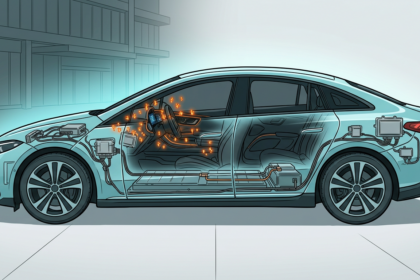
Cutaway anime illustration of a cyan electric sedan showing internal control units under orange threat markers
Cybersecurity

In-car systems overtake IT as the top target for automotive attacks

By
ctadmin
October 18, 2026
India drafts vehicle cybersecurity rules after e-rickshaw hacks
Policy & Compliance

India drafts vehicle cybersecurity rules after e-rickshaw hacks

By
ctadmin
August 1, 2026
Cybersecurity

A passwordless port let a researcher command a moving BYD ute

By
ctadmin
September 21, 2026

CarThreat

Intelligence for the EV and automotive security market
  • News
  • Features
  • Spotlight
  • Events
  • About Carthreat
  • Our Mission
  • Services
  • Contact Us
  • OBD-II
  • Automotive Ethernet
  • TCU
  • Infotainment Systems
  • SDVs
  • BMS
  • ECU Security
  • CAN Bus
  • OTA Updates
  • Vulnerabilities
  • Relay Attacks
  • RCE
  • Threat Intelligence
  • Cybersecurity
  • Digital Keys
  • Bluetooth Security
  • ISO/SAE 21434
  • UNECE R155
  • Regulations
  • Data Privacy
  • EVs
  • Autonomous Driving
  • Pwn2Own Automotive

© 2026 Carthreat.com. All right reserved.  Privacy Policy | Legal

Welcome Back!

Sign in to your account

Username or Email Address
Password

Lost your password?