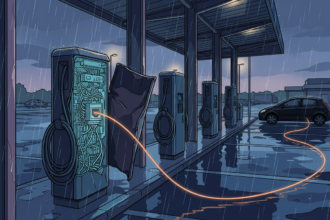



Most attempts to attack a power grid have to get through hardened, purpose-built communications networks. A team at The Hong Kong Polytechnic University has found a cheaper way in: the apps drivers use to pick a charger.
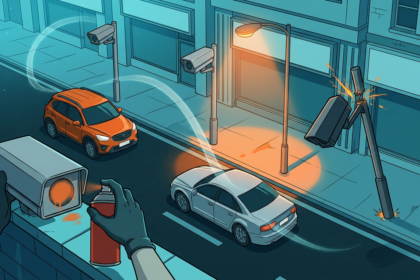
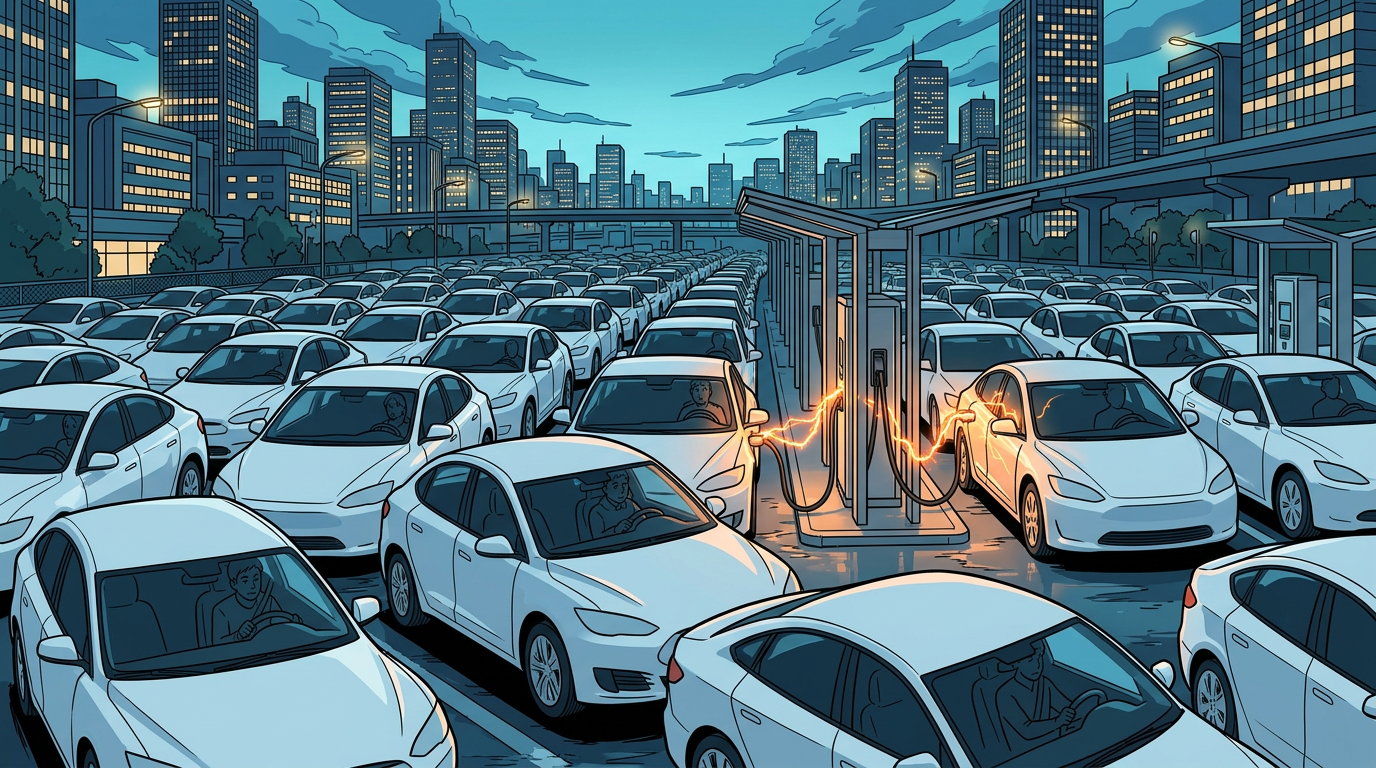
Led by Prof. Bu Siqi of the Department of Electrical and Electronic Engineering, the researchers modelled what happens when someone injects a small number of carefully chosen false data points into charging prices and live traffic flow. Their sparse vector attacks nudge a navigation system’s recommendations just enough that thousands of drivers converge on the same station within a short window.
Two systems, one weak seam
The finding sits at the join between cyber-physical transportation systems, which route and monitor traffic, and cyber-physical power systems, which keep generation and distribution stable. Neither is poorly defended on its own. The risk appears where they exchange data and driver behaviour becomes a control signal for the grid.
Concentrated charging demand in a tight period can trigger local outages or leave the network running with less margin. The paper also flags knock-on effects for reliability beyond the affected feeder.
What would catch it earlier
The study, published in IEEE Transactions on Transportation Electrification, proposes watching for abnormal price and traffic signals, hardening the communication links between the two domains, and spotting unusual recommendation patterns before drivers act on them.
The practical difficulty is that the entry point is public. Charging locator apps are built for convenience and rarely carry the authentication that utility control networks do, which puts an outsized share of the risk on software few operators think of as critical infrastructure.