
Commercial truck makers have spent a decade wiring brakes and steering to the same unauthenticated data bus that carries trailer status and fuel reports. Stoneridge used the IAA Transportation show in Hannover to argue that the wiring pattern itself is the problem.
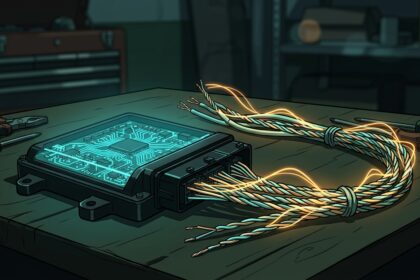
The company unveiled its EVO ECU on the show’s press day, September 14, with a live demonstration planned on an Innovation Truck through September 20. The part is a centralized controller built for heavy vehicles rather than adapted from a passenger car, and its selling point is separation.
EVO runs on a Renesas R-Car system on chip with Green Hills Software’s INTEGRITY real time operating system. A hypervisor enforces hardware-level partition isolation, keeping braking, stability and safety-zone driver assistance in one world and connectivity, telemetry and over the air updates in another. A flaw in the update stack cannot cross the wall.
That architecture is not decoration. EU commercial vehicle type approvals under UN Regulation 155, the cybersecurity management system mandate that took full effect for new heavy vehicle types in mid-2024, effectively require makers to prove safety functions are not reachable from the connected layer.
The gap is real. The J1939 bus underneath most commercial vehicle electronics was designed for reliability, not authentication, so a well placed attacker can inject commands. Researchers from the National Motor Freight Traffic Association told Black Hat USA and DEF CON audiences this year that the Bendix EC80 recall also closed wireless J1939 injection paths, and that fleets never realised their exposure was being fixed alongside the safety defect.
Stoneridge is not the first supplier to pitch isolation, but it is the first to market the claim as a platform for trucks rather than cars.