


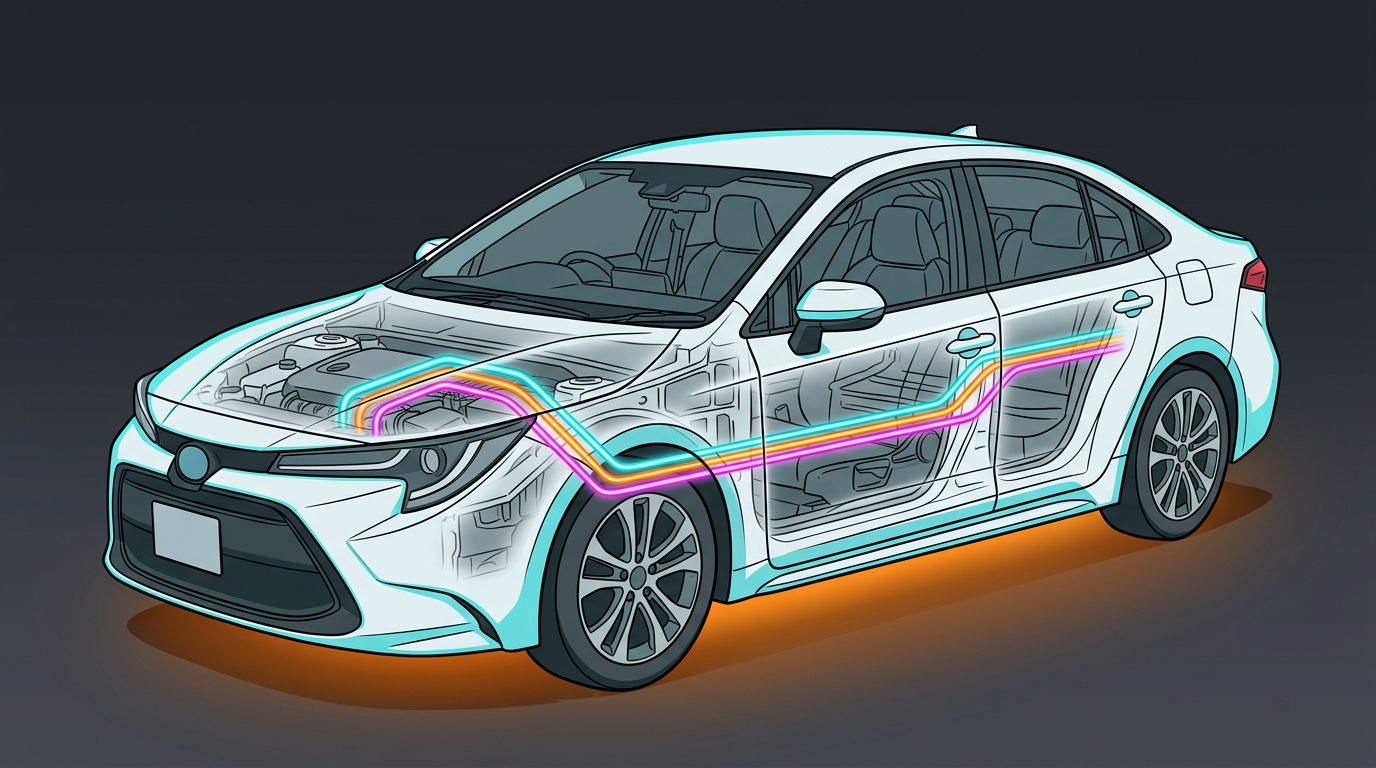
Researchers at Korea University and Kookmin University have released AutoHack, a vehicle security dataset collected from a real 2023 Hyundai driven in live traffic, and say it gives intrusion detection systems a far harder test than simulation-based benchmarks.
The dataset logs synchronized traffic from three CAN buses: the C-CAN, P-CAN, and B-CAN. It includes sophisticated attack scenarios such as UDS-based diagnostics abuse and timing-opaque replay attacks, and the team physically verified the impact of each one, including engine stalls and emergency call activations, to keep ground-truth labels accurate.
The work won the Best Artifact award at VehicleSec ’26, the USENIX symposium on vehicle security and privacy. The researchers note that many existing datasets rely on simulation or simplified periodicity assumptions, which lets models score well by learning dataset quirks rather than real attack signatures.
Results from the AutoHack competition show the dataset challenges state-of-the-art detectors. The paper also benchmarks competition-winning models against representative machine learning algorithms, giving teams a reproducible framework for building generalized vehicle security tools.
By pairing network-level detection with functional safety outcomes, the dataset aims to close the gap between what an intrusion detection system flags and what actually matters in modern automotive architectures. The authors say releasing the dataset, benchmark results, and optimized models should help developers build systems that generalize beyond a single testbed.