




A Korean government-backed consortium is building a single vehicle security chip that bundles quantum-resistant encryption, tamper-proof key storage and intrusion detection. The Ministry of Science and ICT and the National Research Foundation of Korea are funding the effort with 10 billion won ($7.07M) over four and a half years, and Seoul chip designer Ranix leads the group.
Jeon Sang-hoon’s research group at the Department of Automotive IT Convergence receives 1.7 billion won and delivers three of the chip’s pieces. Hardware implementations of ML-KEM and ML-DSA, the two post-quantum algorithms the US National Institute of Standards and Technology certified, form the cryptographic core. The team will also build an intrusion detection system and trial it inside a real car, and write validation tools that probe whether the chip’s random number generator produces keys an attacker could guess.
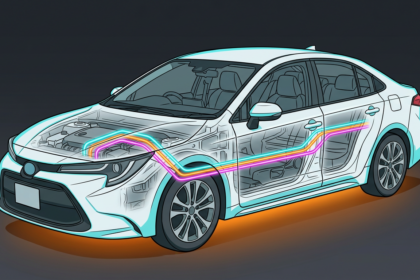
Fusion is the design’s core idea. Rather than running separate monitoring layers for the processor and the vehicle network, the Kookmin system compares both views continuously and interprets a chip-side anomaly together with suspicious bus traffic as one event. The goal is to catch attackers who move between the two domains without either monitor raising an alarm on its own.
The chip consolidates defenses now scattered across separate parts: encryption that resists future quantum computers, a hardware vault for keys, an uncloneable chip fingerprint and a true random number generator. Software-defined vehicles keep growing their attack surface as features move into updatable software, and the UNECE R155 and ISO/SAE 21434 rules push automakers toward hardware-level protection. Hyundai Mobis, Sungkyunkwan University, Ajou University and the Korea Automotive Technology Institute join the research, with Hyundai Motor acting as the buyer. The project runs through December 2030.