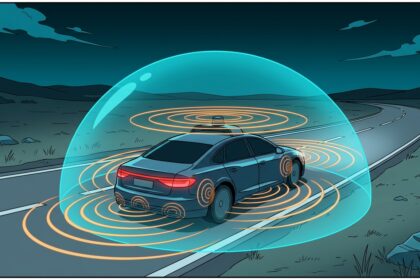





A self-driving car’s view of the road can be moved without touching a single wire or sensor. Engineers at the Technical University of Munich demonstrated the trick using Direction Turning Film, an off-the-shelf optical material that deflects light at a fixed angle.
Placed near a vehicle’s perception hardware, the film bends incoming light so the camera and LiDAR effectively look in a slightly different direction. Nothing is injected into the system and the environment is unchanged, which means detection confidence barely falls even though the vehicle’s mental map has shifted.
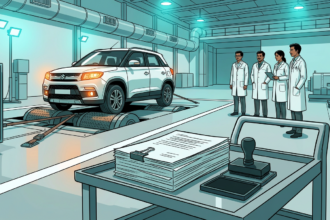
Field tests on a real autonomous research platform plus controlled lab work showed that a 20-degree shift is enough to seriously disturb LiDAR-based odometry and camera-based lane tracking. The researchers warn this could lead a vehicle to drift into oncoming traffic while its object detectors continue to report a perfectly normal scene.
Deployment is straightforward: the material can be fixed to roadside furniture or to parts of the vehicle itself, and the resulting error is hard for the car to diagnose because nothing else about the environment looks wrong. Suggested defenses include physical-layer artifact checks and cross-sensor semantic validation.
The technique adds a fresh category to the physical-world attack literature, one that needs no crafted adversarial objects, no signal injection, and no changes to the target vehicle, only a thin piece of film that redirects where the sensor points. The findings were presented at VehicleSec ’26 in Baltimore.